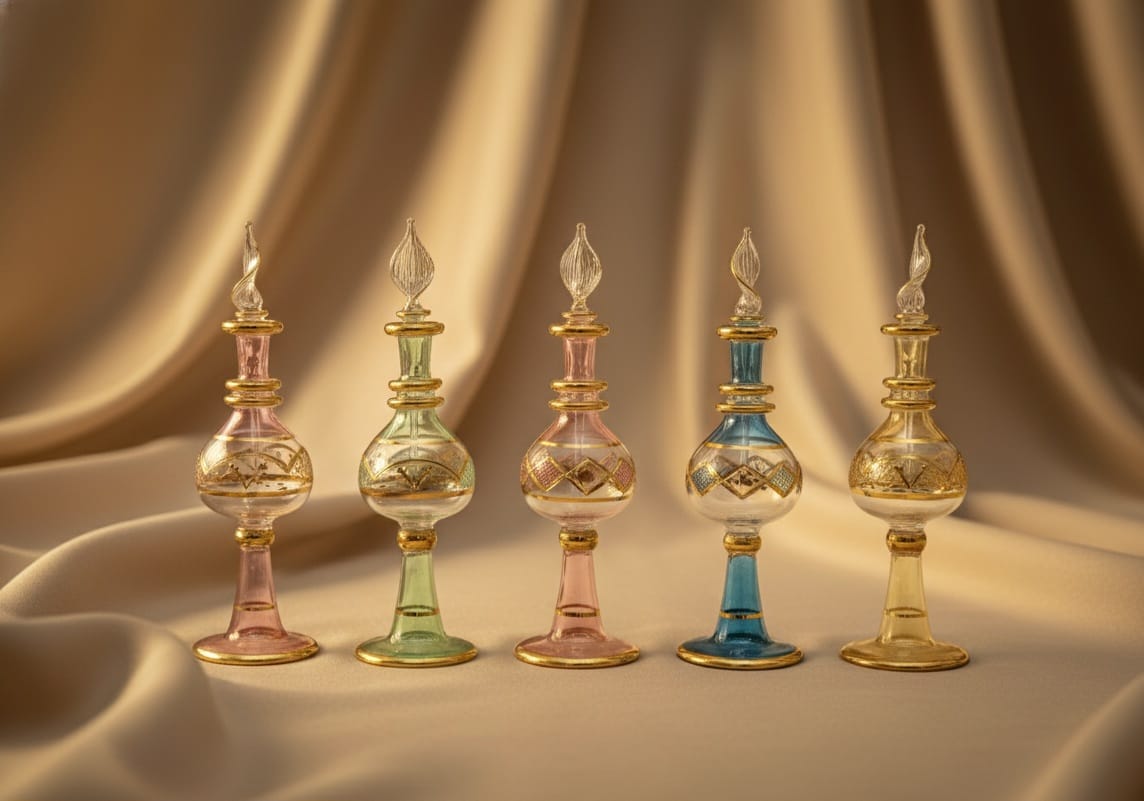
How Hand-Blown Egyptian Glass Is Made: Breath, Borosilicate and 24K Gold
Hand-blown Egyptian glass is made in four stages: borosilicate glass is softened in a flame, shaped by the glassmaker's breath and hand tools without a mould, inspected once cool, and then decorated by hand with 24K liquid gold. At Grand Bazaar Egypt this happens in our own workshop in Cairo, where we have made and exported glass since 2006 for buyers in more than 30 countries.
Why borosilicate glass
Borosilicate glass does not soften easily, and that is exactly why we use it. It is the same resilient glass family trusted in laboratories and kitchenware: clearer and stronger than the soda-lime glass used in most mass-produced décor, and better at handling heat without stress. It is also food-safe, which matters for perfume and oil bottles, drinkware and tamriya date dishes.
Stage one: the flame
Work begins with clear borosilicate glass turned slowly in a flame until it softens and glows. This is the only moment the glass can be shaped. For a few minutes it can become a bottle, a sphere, a stem or a ruffle; then it sets.
Stage two: the breath
The glassmaker blows into the softened glass to form a bubble, then shapes it while it is still hot: stretching a neck, rounding a body, pinching a ruffle, joining one sphere to another. There are no moulds in our workshop. Wall thickness, curve and proportion are judged by eye and hand, in seconds.
This is why no two pieces are identical. A slightly fuller sphere or a ruffle that leans a little to one side is not a flaw. It is the signature of the hand and breath that made it. Buyers who want to understand how to tell this apart from moulded glass can read our guide on hand-blown vs moulded glass.
Stage three: cooling and inspection
Each piece cools slowly so the glass settles without internal stress. It is then inspected for strength, balance and finish. Pieces that do not meet the standard do not go on to the gilding bench.
Stage four: 24K liquid gold by hand
At the gilding bench, 24K liquid gold is applied by hand with a fine brush: rims, bands, lattice patterns, leaves and dots. The work is slow and depends on a steady hand, which is why gold decoration is one of the clearest differences between handmade and mass-produced glass. Under close light you can see the small differences in each stroke.
After the gold: packing for export
Finished pieces are cleaned, checked again and packed for the journey. Each piece is individually wrapped and set in honeycomb dividers inside reinforced export cartons. We photograph every carton before sealing. If anything breaks in transit, report it within 48 hours with a photo and we replace or credit it.
What we make this way
The same process produces our whole range: perfume and attar bottles from 3 to 100 ml in more than 80 models, decanters from 130 ml, mabakhir (incense burners) from 13 to 35 cm, bakhoor jars, oil burners, Candela candlesticks, vases and candy jars, tamriya date dishes, Christmas ornaments, gift sets and drinkware. Browse the full range in our catalogue, or read more about our workshop on the craft page.
Timelines for buyers
Core perfume bottles (models 01–35) and mabakhir are kept in stock in Cairo in mixed colours and dispatched in 2–3 business days. Specific colours are confirmed within 24 hours or made to order in 15–25 days. Custom colours and gold patterns start from 100 pieces per design, with production of 20–30 days from sample approval.
See the craft up close with a Discovery Set, from $99 with express shipping included.