The Hidden Symbolism in Egyptian Glass Art
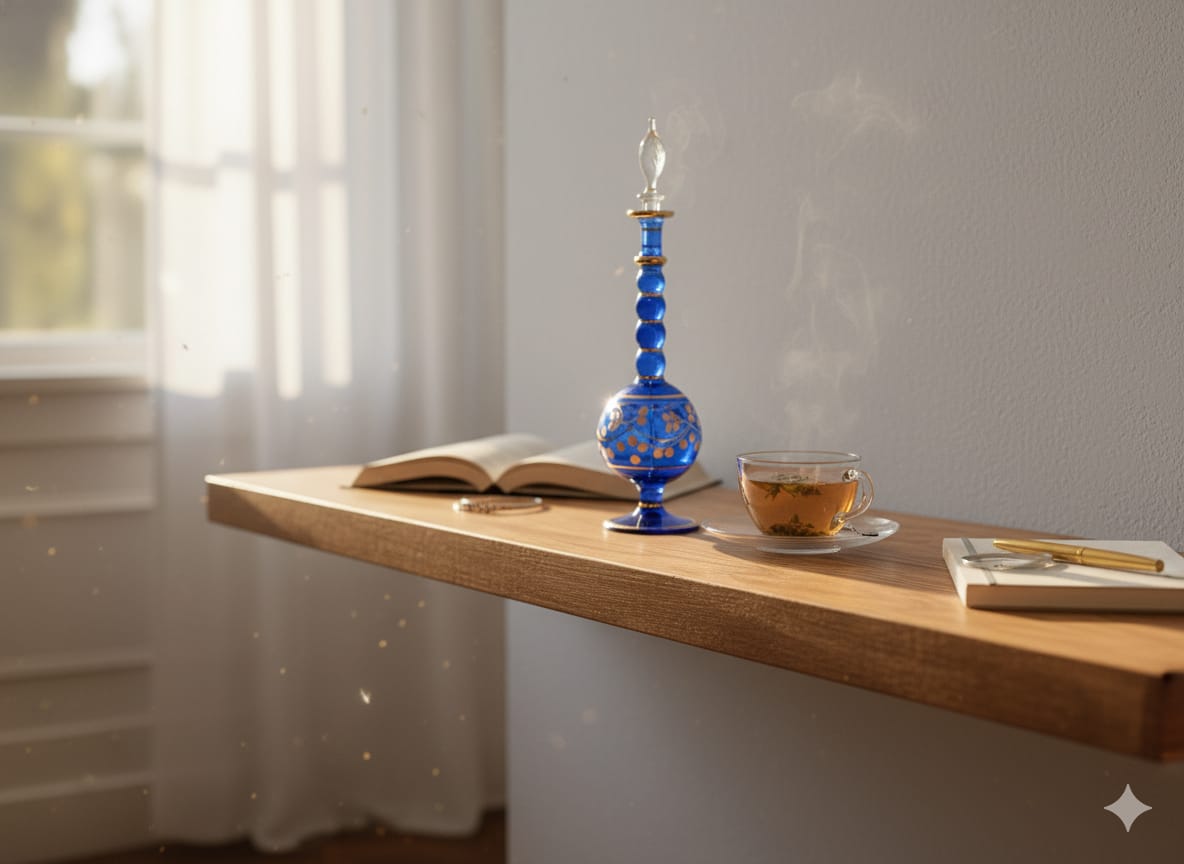
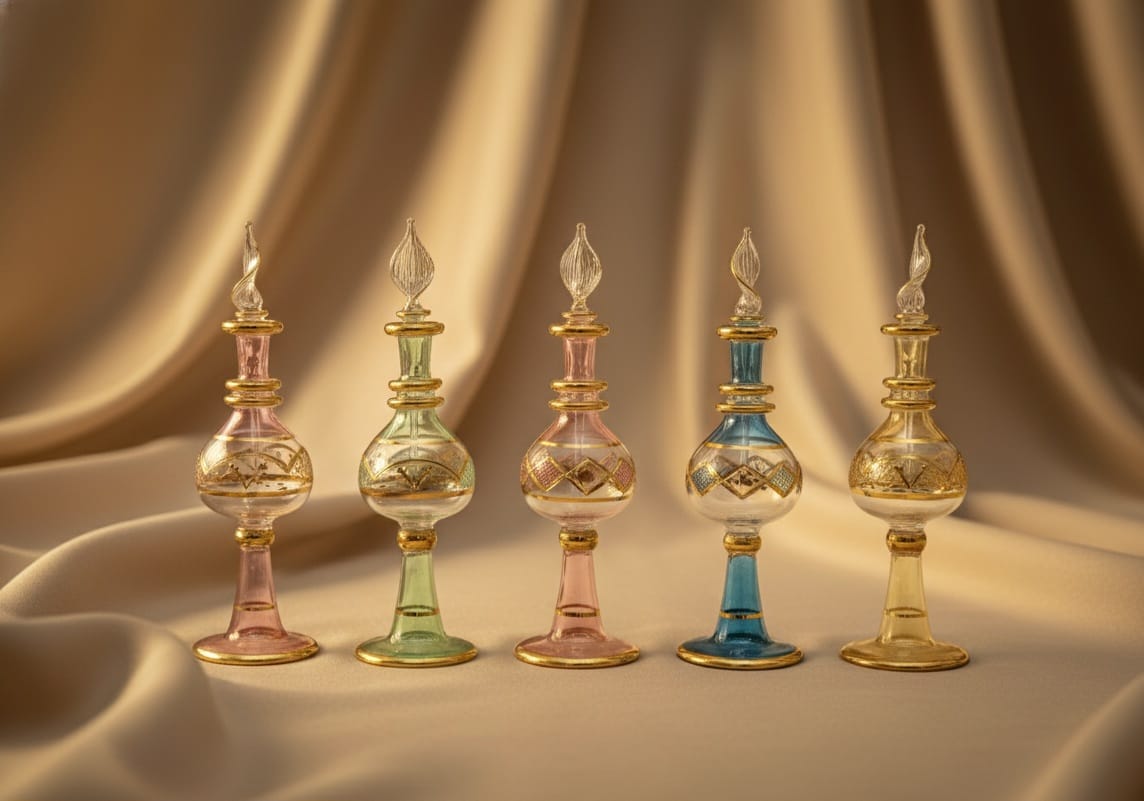
The patterns on traditional Egyptian glass are a visual language borrowed from Cairo's architecture: the mashrabiya lattice, the shamsa sunburst, the qubba dome, the muqarnas honeycomb vault and the tiraz band. At Grand Bazaar Egypt, these motifs guide the shapes and the hand-applied 24K liquid gold on the mouth-blown borosilicate pieces we make in our Cairo workshop, from perfume bottles to mabakhir and incense burners.
Why symbolism matters to buyers
For importers and retailers, the meaning behind a design is a selling point. Customers buying a mabkhara for their home, or a perfume bottle as a gift, often want to know where the pattern comes from. A piece with a story sells more easily, and justifies its price, compared with decoration that has no origin.
The mashrabiya: the screen that filters light
Old Cairo built carved wooden lattice screens across its windows. They gave privacy from the street and broke harsh sunlight into soft patterns on the floor.
In glass, the same idea appears as a net of fine gold lines applied by hand around the body of a bottle or burner. What the screen did for a room, the gold does for the light passing through the glass.
The shamsa: the little sun
On the façade of the Al-Aqmar mosque in Cairo, a carved medallion has looked down on al-Muizz Street since 1125. Egyptians call this motif a shamsa, a little sun. It stands for light and radiance.
In glass work, it appears as gilded rosettes and as radiating lines painted outward from a central point, often on the lid or the shoulder of a piece.
The qubba: the dome
Cairo's skyline is a conversation between domes. The dome curve is one of the most natural shapes for blown glass, because a breath into molten glass forms a sphere. Stacked spheres become candlesticks, lids for bakhoor jars and the tops of mabakhir.
The muqarnas: the honeycomb vault
Above the gates of the old city, stone steps downward in rows of small cells like a honeycomb. It is one of the most mathematical forms in Islamic architecture. In glass it is suggested rather than copied: stacked discs, stepped rims and repeating gold cells.
The tiraz: the band of honour
Fatimid workshops wove inscribed bands onto robes to mark the rank of the wearer. On glass, the tiraz becomes a ring of gold around the neck or the waist of a piece, often between two thinner lines. It is one of the most common, and most recognisable, decorations on Egyptian perfume bottles.
Colour as meaning
Colour often carries its own associations in our markets. Deep blue and turquoise recall protection and the sky. Green is linked to paradise gardens and is popular for Ramadan. Amber and gold suggest warmth and generosity, which is why they lead in gifting. Clear glass with gold is the most versatile choice for buyers who serve a wide range of customers.
Where the symbols appear in our range
These motifs run through our perfume and attar bottles, bakhoor jars, oil burners and especially our diffusers and incense burners. Mabakhir, from 13 to 35 cm, carry the richest decoration because they are display pieces as well as functional ones.
Because each piece is mouth-blown and gilded by hand, the same motif will vary slightly from one piece to the next. That variation is part of handmade glass.
Using the story in your shop
A short line on a shelf card or product page is enough: "Gold lattice inspired by the mashrabiya screens of old Cairo. Mouth-blown and gilded by hand." Our craft page has more background you can share with your team.
For a design of your own, custom colours and gold patterns start from 100 pieces per design. Wholesale orders start from $250 in total, models and colours mixed.
See the patterns in person with a Discovery Set, from $99 with express shipping included.